
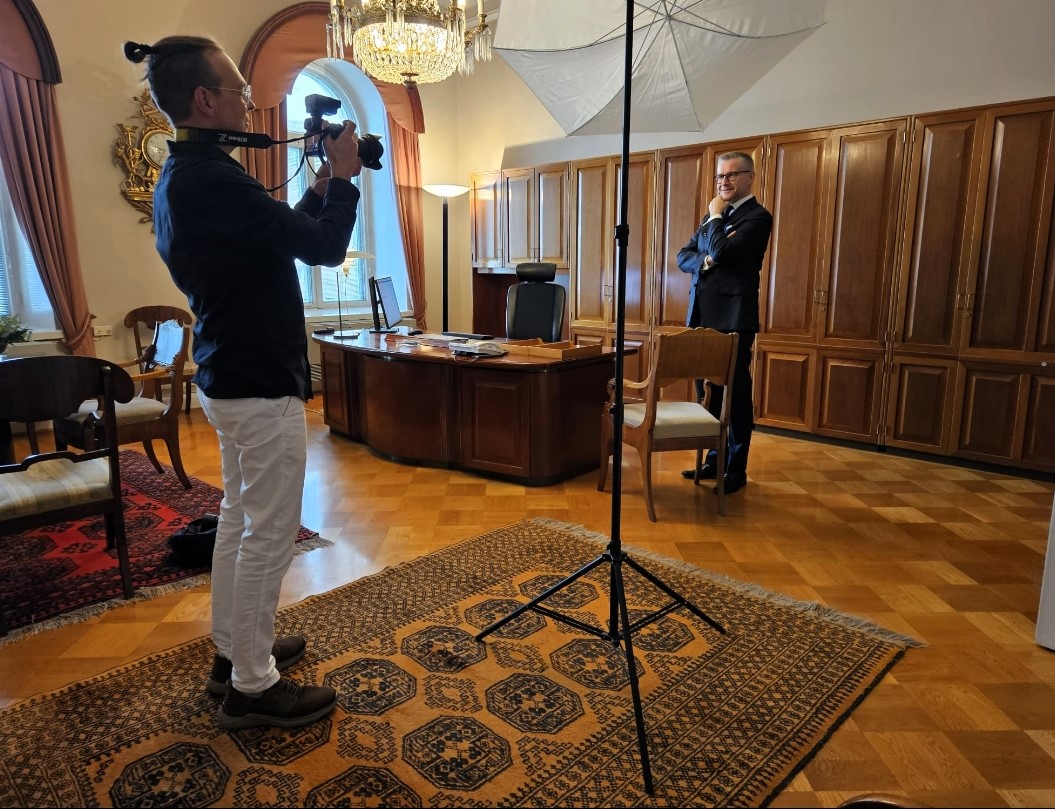
From the Faculty to the Office of the Chancellor of Justice
I began serving as the Chancellor of Justice, the supreme guardian of the law, at the beginning of September 2025. I moved into my new position from the Faculty of Law at the University of Turku. I had worked at the Faculty for a long time in various research and teaching positions. Most recently, I was a Professor of Public Law and served as the Dean of the Faculty. Alongside my own teaching and research work, I have carried out many different legal expert tasks. Lately, I have also led large multidisciplinary research consortia focused on the study of crises. I continue my research work within academia, and I teach a course at the Faculty as well. I am planning a new course too. Currently, I am engaged in significant expert work for a major science funding institution in Sweden. I have the pleasure of continuing as the chair of the Finnish Society of Legal Sciences as well.
One particularly valuable aspect of working at the Faculty has been the long-term exposure to colleagues’ ways of thinking and their immense knowledge, as well as the opportunity to be close to and part of research-based information. Working in a multidisciplinary university has likewise been beneficial. The various expert tasks both within and outside the university have included elements very similar to those of my current role as Chancellor of Justice.
Research and teaching also involve the ability to listen and learn from others, as well as the critical examination of one’s own ideas. In this regard, close contact with both colleagues and students has been of utmost importance. These skills are helpful in any job.
The Chancellor of Justice of the Government of Finland serves as the supreme guardian of the law. According to Section 108 of the Constitution of Finland, the Chancellor of Justice shall oversee the lawfulness of the official acts of the Government and the President of the Republic. The Chancellor of Justice shall also ensure that the courts of law, the authorities and civil servants, public employees and other persons, when the latter are performing a public task, obey the law and fulfil their obligations. The Chancellor of Justice monitors the implementation of basic rights and liberties and human rights. In addition, the Chancellor of Justice shall, upon request, provide the President, the Government and the Ministries with information and opinions on legal issues. Individuals can file complaints with the Chancellor of Justice about an authority’s activities that they suspect to be illegal.
The Office of the Chancellor of Justice supports the Chancellor of Justice and the Deputy Chancellor of Justice in their work. The Office is led by the Chancellor. The Secretary General manages the Office’s internal operations and ensures its performance and development.
The Office of the Chancellor of Justice prepares matters to be decided by the Chancellor of Justice and performs other tasks within the Chancellor of Justice’s area of responsibility, such as tasks related to inspections and international cooperation. The Office of the Chancellor of Justice also acts as a centralised external reporting channel for whistleblower protection. I have already noticed that the experts working in the Office are highly skilled and experienced.
The Office of the Chancellor of Justice is an independent office. The Office has always been situated in the Government Palace overlooking Senate Square, opposite the University of Helsinki Main Building. My office room, with some artefacts from the early days of autonomous Finland, has windows facing the Square. The building has served as a government palace since 1822. Weekly, I enter the Presidential Room and the Government Session Hall through the main vestibule of the Palace, where Eugen Schauman shot the Russian Governor-General Nikolai Bobrikov and himself in 1904, a place and event that are indeed among ‘lieux de mémoire’ of Finland. Before Finland gained its independence, the Chancellor of Justice was called Procurator. The first Chancellor of Justice, P. E. Svinhufvud, who later became one of the first Presidents of independent Finland, was the last Procurator. Interestingly, the first Procurator was Matthias Calonius, after whom our Faculty building is named.
My working weeks depend very much on the supervision of the Government and the President of the Republic. Weekly, in the preparatory phase of decision-making, the Chancellor of Justice, upon request, provides them with statements and information on legal issues related to the decisions of the President of the Republic and the government plenary sessions. The Chancellor also inspects all the documents presented to the Government and the President for the decision-making in advance. In addition, the Chancellor of Justice is present at decision-making gatherings, including the government plenary sessions and the presidential sessions. For supervisory purposes and for providing information, I attend the government cabinet sessions and negotiations too. After the decision-making process, the Chancellor checks the minutes and processes any complaints concerning the decisions. In addition, the Chancellor of Justice may, on their own initiative, examine a decision in which there is reason to suspect an erroneous procedure. The Chancellor of Justice also investigates complaints concerning the official duties of the Government, the President, and other authorities. Thus, the work includes a substantial amount of reading and writing.
I feel that my previous work has prepared me well for my current duties. My research has, broadly speaking, covered the very field in which I now work. Of course, these days I often have to take a position on various matters quite quickly, and in complaint cases I try to make decisions continuously, because the number of issues to be resolved each week is so large. With a skilled staff, this is certainly manageable.
I am still getting used to the level of public visibility that comes with my new role. In my previous expert position, I was able to adjust public exposure myself. Now, of course, that is not possible, because, for example, my actions related to the exercise of public power are recorded in a public register and are accessible to the media.
Looking from a distance, I see clearly that the Faculty carries out extremely meaningful, excellent and impactful work. For example, within the state administration, there is an enormous range of career opportunities for lawyers educated at the Faculty. In addition, there is a tremendous demand for research-based knowledge about law. In our time, it often feels as if established understandings are being challenged from many directions. In such circumstances, there is a particular need for research on general doctrines and legal concepts, as well as for historical, theoretical, and critical perspectives on legal issues.
Janne Salminen
Photo by Krista Kukkanen (Office of the Chancellor of Justice).